


The Emerging Challenge of PFAS in Sediments
For more than a decade, cleanup of per- and polyfluoroalkyl substances (PFAS) has been driven primarily by protection of drinking water supplies. As regulatory programs mature, attention is expanding to other environmental media and exposure pathways, including sediments.
Unlike drinking water, there is limited precedent for PFAS sediment screening levels, cleanup criteria, or remedy-selection frameworks. Yet site owners and project teams are beginning to make consequential decisions about how to manage PFAS in sediments before a regulatory framework is fully established.
The challenge is not simply determining whether PFAS are present. It is understanding what their presence means, whether they pose a significant risk, and what—if anything—should be done about it.
How PFAS Behave Differently From Other Organic Legacy Sediment Contaminants
The environmental industry’s experience managing legacy contaminants such as polychlorinated biphenyls (PCBs) since the 1970s provides useful context for evaluating PFAS in sediments. However, it doesn’t provide all the answers.
PFAS encompass thousands of compounds with different properties that impact their fate and transport in the environment. Unlike PCBs, the types of PFAS that have been the primary focus of regulation to date, perfluoroalkyl acids (PFAAs), have a relatively low affinity for sediments. This means these chemicals do not bind as readily to the sediment as legacy organic chemicals like PCBs do. Research has shown that once the source of these PFAAs is controlled, concentrations will likely decline rapidly in sediments, the water column, and fish. For low-affinity PFAAs, the key to reducing water column concentrations is upland source control rather than active sediment remediation.
Other PFAS, known as precursors, can behave quite differently. Some have a higher affinity for sediments, meaning the sediments may act as a source of these precursors to the water column. This is similar to how PCBs behave. Because precursors can transform into PFAAs over time, they may continue to contribute PFAAs to the water column even after upland sources have been controlled. But more work is needed to fully understand the impacts of precursors in sediment on the decline of PFAA concentrations after source control.
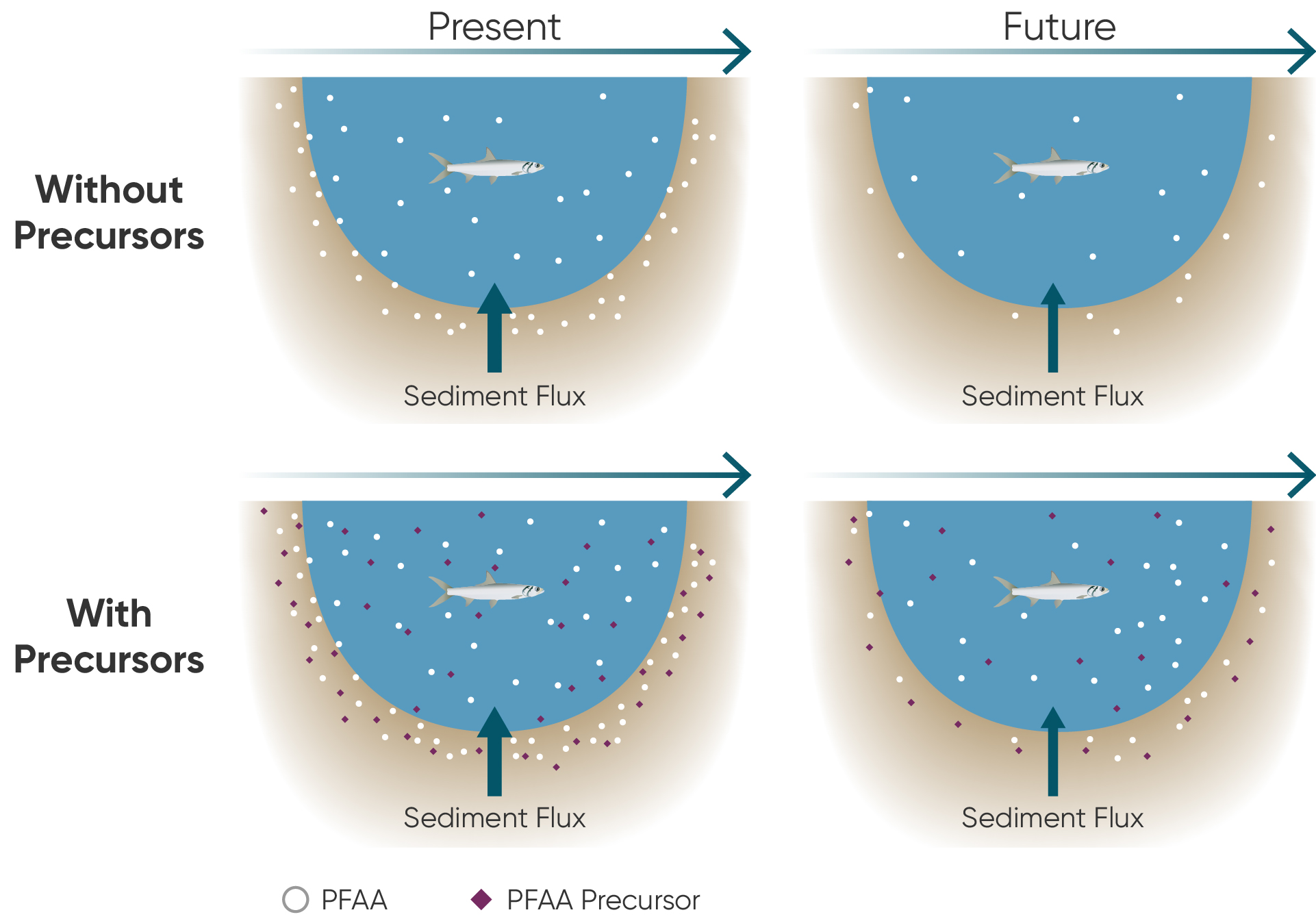
Following source control, precursor transformation rate and sorptive strength will determine future PFAS concentrations.
In some cases, regulators focus on sediments because they may be an ongoing source of PFAS to fish through the food web. This focus reflects upon experience where sediments containing PCBs are known to be a source of the chemical to the fish. When there are PCBs in the sediments of an aquatic system, active sediment remediation may help reduce contaminant concentrations in fish. However, researchers are still studying the dominant sources (sediment and/or water) that control PFAS in fish and seeking to understand what happens to PFAS chemicals once they are inside a fish.
These uncertainties and the differences between PFAS and legacy organic chemicals raise key questions:
1. What controls the PFAS concentrations found in fish?
2. Would active sediment remediation help significantly reduce these levels?
Understanding Where the Risk Comes From
Answering the questions above starts with understanding what controls PFAS levels in fish and how fish will respond as PFAS levels in water and sediment decline. The approach needs to be site-specific, which means examining concentrations and trends in sediment, surface water, and aquatic organisms; identifying ongoing sources of PFAS; and assessing how the chemicals move through the system and how conditions may change once the source is reduced or eliminated. This is critical to establishing the conceptual site model—a picture of contamination sources, movement, and exposure pathways—that will help practitioners understand what may occur on their site and how it may respond to any remediation.
Given what we currently know about the behavior of PFAS in the environment, source control is a key consideration. If PFAS continues to enter from an upstream or upland source, sediment remediation alone may provide limited long-term benefits. Controlling the source could be the key to concentrations declining over time.
Making Sound Decisions While Science and Regulations Evolve
For organizations managing PFAS liabilities, the challenge extends beyond whether there is a numerical threshold and whether the sediments they are managing exceed that level. Decisions made today can affect cleanup costs, the durability of remedies, regulatory obligations, and long-term liability even as standards and guidance continue to evolve.
The objective should be to make decisions that protect people, communities, and the environment and are technically defensible without assuming that every PFAS detection requires the same response.
How does a practitioner proceed in the face of uncertainty? Stepping back and building a robust conceptual site model can help teams identify data needed to understand what is happening in the system and better evaluate options for reducing PFAS levels in water, sediment, and fish.
Engaging with regulators as this conceptual site model is developed can help establish what evidence to gather, which uncertainties matter most, and which path is the most technically defensible. Using site-specific conditions, the optimal path begins with upland source control rather than immediate sediment remediation. Ultimately, the appropriate response should be judged by its ability to meaningfully reduce risk. Detection starts the investigation; reducing risk is the measure of progress.
Jennifer Benaman, PhD, is the PFAS Initiative Lead at Anchor QEA.
Contact Jennifer to learn more.